Making the most of your metadata: Visualising literary correspondence
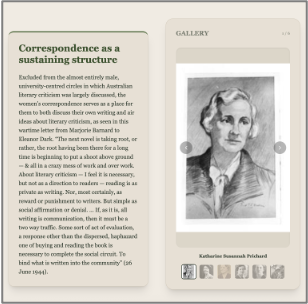
As an undergraduate I read As Good As a Yarn With You, Carole Ferrier’s weighty collection of letters gathered from the archives of six Australian literary women who corresponded with each other in the middle decades of the twentieth century. It stayed with me as a powerful record of the sheer weight of what these women struggled against - wartime paper shortages, the drudgery of earning a living from the clerical positions open to them, the time lost to caretaking and domestic duties expected by male relatives, an Australian literary establishment geared to celebrating the opinions and consolidating the authority of men, especially those with university positions and editorial responsibilities - as they sustained a sense of themselves as writers, honed their craft, supported each other and carried out the work of building an Australian literary culture through the relatively few institutions open to them, such as the Fellowship of Australian Writers.
In the intervening years I have occasionally thought to myself, “I really should explore the metadata from those letters with network analysis, geospatial analysis, topic modelling and so forth”, and then life has intervened. But a few days ago Shawn Graham released Polybius, a static site generator for visualising different aspects of historical datasets, and this was the push I needed to knock the metadata from my print volume into shape. The resulting site, Visualising correspondence from the archives of Australian literature, uses a scrollytelling format to present different views (network, map, timeline, statistical chart, image gallery) of a CSV. There are limitations, which I felt most strongly with the network visualisation, but for what it is - a visually appealing, low-technical-barrier-to-entry way of quickly generating multiple views of a dataset, which could be used in a presentation or as a proof of concept in a funding application - it is a nice addition to the collection of DH resources for those without high-level programming skills or access to research software engineers. Also, static HTML websites are <chef’s kiss>. Thanks, Shawn!